

Sounds taught me leather.
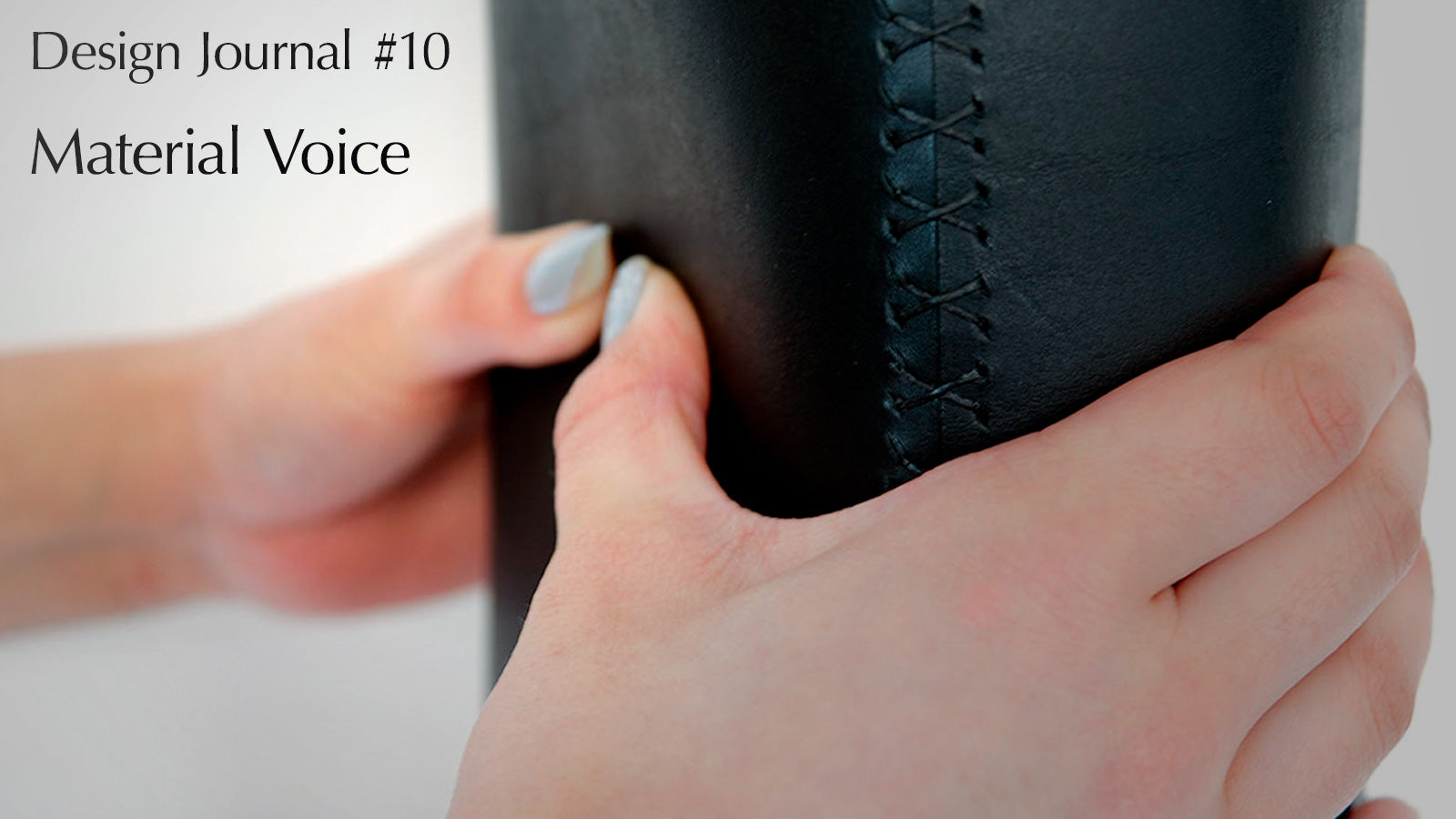
Most people are surprised when they first encounter a SYRINX speaker.
Because the body is soft.
Speakers are typically expected to be robust, box-shaped enclosures. But SYRINX speakers are cylindrical, wrapped in leather, and yield to the touch of a finger. Any doubts about whether they can produce sound vanish the moment they play.
So, why is it soft?
The Contradiction of Box-Shaped Speakers
The sound quality of a speaker isn't solely determined by the driver unit. The enclosure that houses it significantly impacts the sound.
Hard materials resonate. No matter how precisely they are made, they will reverberate if struck. The reverberations echoing within superimpose on the original sound, causing muddiness.
So, are soft materials better? Soft materials readily dissipate vibration energy as heat, leaving less unwanted resonance. However, this introduces another problem.
Soft, highly sound-absorbent materials are generally light. Light materials transmit sound. The out-of-phase sound from the back of the speaker unit passes through the enclosure, canceling out the sound from the front. Low frequencies, in particular, are prone to diffraction, leading to a loss of richness.
Sound absorption or sound insulation? This is a contradiction in material selection that is not easily reconciled.
Until We Reached Leather
To resolve this contradiction, we tested many materials.
The material requirements narrowed down to three: no resonance, sound absorption, and sufficient weight for sound insulation.
Soft materials are light, and heavy materials are hard. Faced with this dilemma, leather emerged as a candidate.
Leather, with its densely interwoven fibers, has high internal loss and resists resonance. It is highly airtight, so sound insulation can also be expected. However, even with leather, heavier materials tend to be hard, and softer materials tend to be light.
We searched for leather that was both soft and heavy.
Encountering Vacchetta Leather
What we found was Italian Vacchetta leather, rich in oil.
This manufacturing method involves slowly impregnating cowhide, tanned with vegetable tannins, with oil. This oil gives the leather weight while maintaining its flexibility. Heavy and soft. A single piece of leather resolved the acoustic contradiction.
The reason leather was chosen for the speaker enclosure was not for its appearance or texture. The acoustic requirements inevitably led to this material.
The Absence of Core Material
The development of the speaker left one design principle.
To accurately understand the characteristics of a material and to create a design based on those characteristics.
Core materials are a means to supplement the characteristics of a material. If leather is too soft, it is reinforced with a hard core material. That in itself is a rational approach. But I do not prefer it.
Adjusting with a core material might be akin to masking the natural flavor of ingredients with seasoning. Because it means overwriting the inherent characteristics of a material with another material.
Rather than choosing materials, we follow them. That is the starting point of the design.
A Question That Lives On In Wallets
Hitoe® Fold features a unique inner hook clasp. Opening and closing it requires bending the wallet into a V-shape.
The leather must respond to this action. If it's too stiff, you'll feel resistance every time you bend it. If it's too soft, it lacks firmness and doesn't feel substantial. The goal is to achieve just the right comfortable feel, combining softness with appropriate firmness, without using any core material.
Therefore, the selection of leather is meticulous. Because the characteristics of the material directly translate into the user experience.
The Aria and Less series have a structure made by bonding two pieces of leather together. Here, too, no core material is used. The combination of the inner and outer layers achieves the necessary rigidity and flexibility. Adding a core material would make it thicker. The concept of pursuing thinness and the philosophy of not using core materials are not contradictory. They are different expressions of the same idea.
The Question Remains Unchanged
SYRINX began as an audio brand.
When I chose leather for the speaker enclosure, I learned how to approach materials. The acoustic requirements taught me the essence of leather.
Currently, the speaker business operates on a custom-order basis only. However, the way we pose questions has not changed.
When selecting leather, I still ask the same questions: What is this material good at? What is it not good at? What kind of design is needed to utilize its characteristics?
Listening to the voice of the material.
That is the origin of SYRINX's design.
(Text by Hirotaka Sato | SYRINX Representative and Designer)
![Small, thin wallet [Mottainai] Hitoe® Fold - Liscio - v.2023 | Vacchetta leather that deepens in color and luster](http://syrinx.pro/cdn/shop/files/Fold-Liscio-Top-camel.jpg?v=1783646255&width=533)