

Mushroom-Derived Leather Alternative: Towards a Sustainable Future
What are plant-derived leather alternatives?
In recent years, with growing environmental awareness, "plant-derived leather alternatives (vegan leather*)" have garnered significant attention.
The planet can no longer sustain the current high levels of meat consumption. Methane gas from cattle burps and flatulence is estimated to account for about 5% of total greenhouse gas emissions.
To address this issue, the development of plant-derived meat alternatives is progressing, and in the future, the number of cattle raised may decrease, necessitating alternative materials for leather as well.
Against this backdrop, development is advancing worldwide, and numerous plant-derived leather alternatives have emerged, including those made from pineapple leaves, mushrooms, cacti, apples, and coffee beans.
*The use of the term "leather" in "vegan leather" does not comply with JIS standards, so it will be referred to as "leather alternative" below.
Challenges of leather alternatives
With current technology, it is difficult to replicate the properties of leather, which have been improved over a long history, using only plant components. Therefore, most plant-derived leather alternatives are reinforced with plastics (such as polyvinyl chloride and polyurethane). This includes many derived from mushroom mycelium.
While plant-derived polyurethanes do exist, they contain only a partial amount of plant components and also include petroleum-derived components, leaving many challenges in terms of durability, biodegradability, and texture.
Misconceptions spreading with leather alternatives
The shift from petroleum-derived raw materials to plant-derived ones is a sustainable and wonderful trend.
However, the fundamental problem is not whether it is plant-derived or petroleum-derived. It is the environmental impact of plastics, which are present in both.
Furthermore, the problem is that many manufacturers and sellers have seized this as a business opportunity, treating "plant-derived" as synonymous with sustainability without mentioning the plastic content. This includes global high-end brands and large corporations.
As a result, the potential for greater environmental harm than natural leather has been obscured, and conversely, the misconception that "leather is bad for the environment" has spread.
Plastic-free leather alternatives
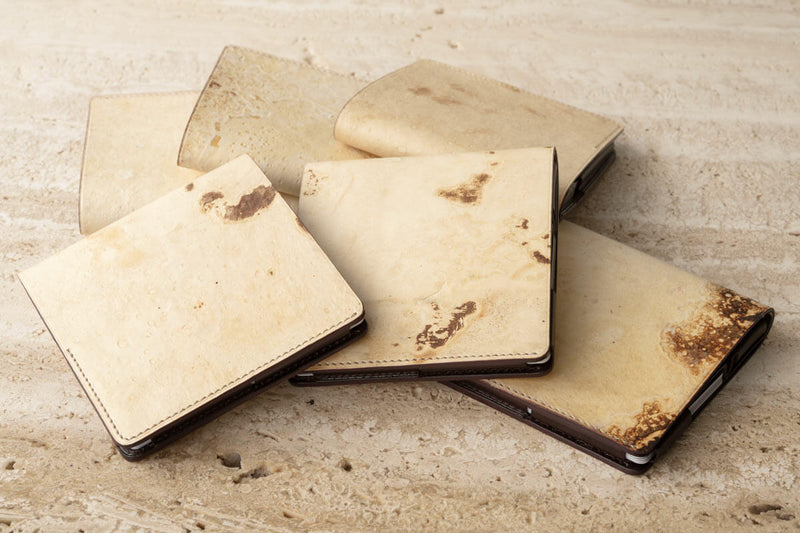
"MYCL," a mushroom-derived leather alternative, is the plastic-free, circular material we have been waiting for.
This groundbreaking new material is made using mushroom mycelium. By leverpatina the fact that mushroom mycelium has a natural fibrous structure similar to leather, it achieves strength and durability comparable to leather.
It uses no dyes or coloring and minimizes the use of chemical substances.
The brown parts are traces of the mycelium attempting to grow into mushrooms, and each piece has a unique character, allowing you to enjoy the mushroom's texture.

From hide to leather
Since the Paleolithic age, humans have not only used hunted animals for food but also for survival, transforming their bones into tools and their hides into clothing. The transformation of perishable animal hides into durable leather is a testament to human ingenuity for surviving harsh environments.
Furthermore, cows are not killed for the purpose of making leather. Hides are a byproduct of the meat industry. If hides are not transformed into leather and utilized effectively, they would have to be incinerated, releasing large amounts of CO2.
Leather, which upcycles the hides that are byproducts of the lives given, is a sincere respect for life and an indispensable presence for reconciling meat consumption and environmental conservation.

Partners for the future
Examples of combining plant-derived leather alternatives with animal-derived leather are rarely seen.
However, using plastic to compensate for properties that leather alternatives lack increases the environmental burden.
"MYCL," a mushroom-derived leather alternative, is a plastic-free, circular material.
Cowhide tanned with vegetable tannins is also a material that uses almost no chemical substances and returns to nature.
These two sustainable materials are not contradictory. They are partners with many similarities that can complement each other for a sustainable future.
SYRINX believes this combination is one of the ideal environmentally friendly options and will continue to explore and address our responsibilities.
