

Unreliable shape
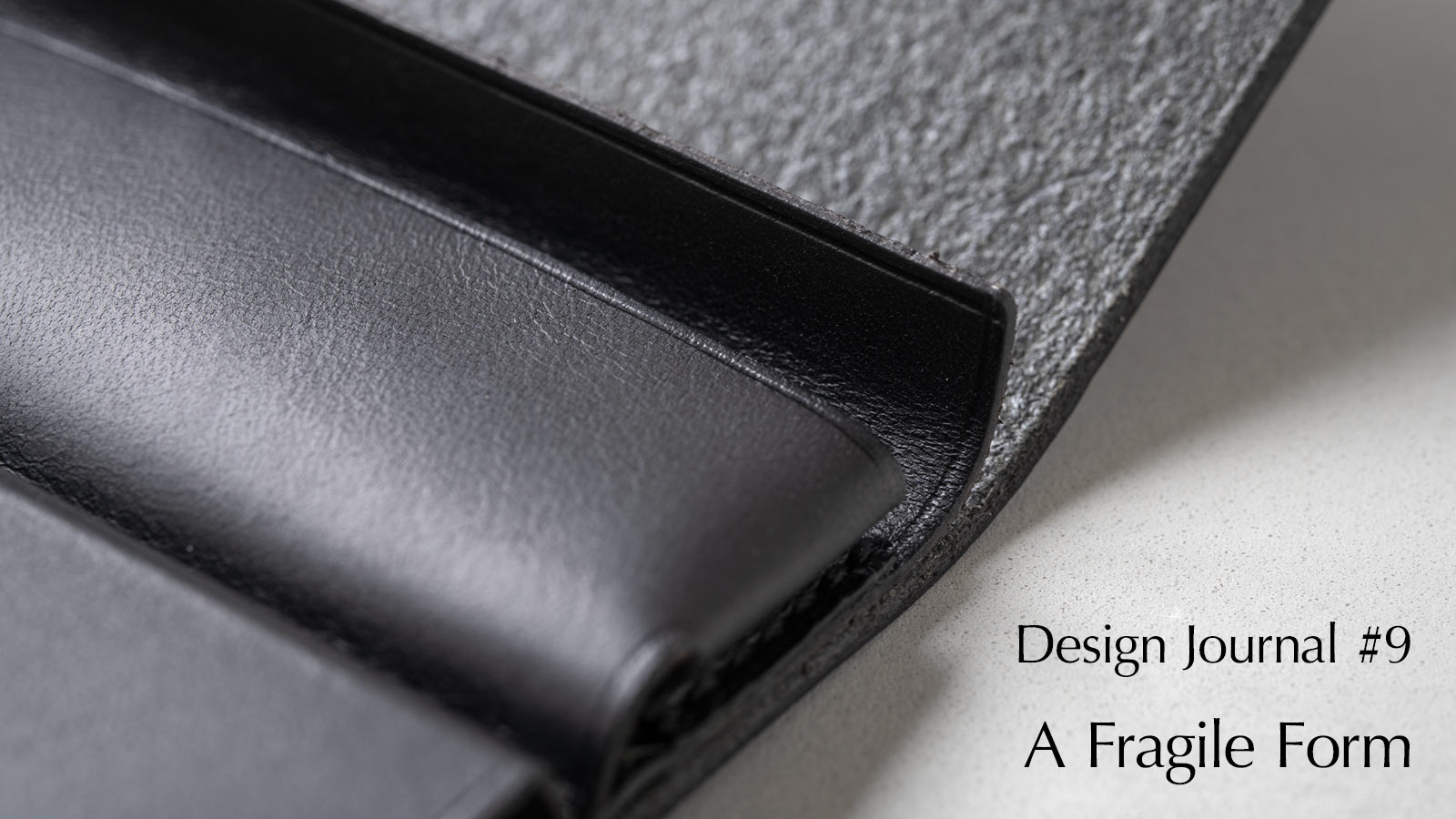
The catalyst was a single question.
"How should the coin pocket be closed? Or, how should it be partitioned?"
Though often an inconspicuous component, this is an unavoidable challenge when designing a wallet.
Zippers, snaps, deep flaps.
These can certainly close the pocket. However, in exchange, they add more steps and create bulk.
Isn't there a simpler, more functional form?
From that question, the short flap was born.
The short flap: an answer.
What we arrived at was a small, seemingly unreliable element that ambiguously covers or doesn't cover the opening.
However, this short flap is not merely a "lid."
|To prevent coins from falling out.
The small leather piece at the top of the coin pocket.
In fact, this is sufficient to prevent coins from falling out.
As you use the wallet more, it naturally forms a curved shape, further increasing its security.
Moreover, because it only covers the top part of the coins, it has almost no impact on the overall thickness.
|Doesn't obstruct visibility.
With many coin pockets, you can't see the contents without opening a substantial lid.
That small extra step becomes an obstacle to using coins daily.
The short flap doesn't cover too much.
You can naturally check your coins without conscious effort.
|To protect banknotes.
Banknotes are prone to getting dirty if they touch coins and are prone to creasing if they touch cards.
The short flap protects banknotes from these.
There's also a reason why it's a continuous, integral part, seamlessly connected to the coin pocket.
This is to prevent extra creases or marks on banknotes, even when they are pressed by the pocket.
The short flap is not merely a lid.
It also serves as a partition to protect banknotes.
Accumulated thought.
Prevents coins from falling out.
Doesn't obstruct visibility.
Protects banknotes.
To fulfill all these requirements with a small, seemingly unreliable part.
Before the advent of Hitoe® Fold, I had never seen a wallet with this short flap.
This is because coin pockets were assumed to be securely closed.
The question itself probably didn't exist for that assumption.
Even for things we take for granted, we delve deeply into questioning them.
There might be a different answer there.
We accumulate thought down to the smallest detail.
That is the form of SYRINX's thought process.
(Text by Hiroaki Sato|SYRINX Representative and Designer)
![Small, thin wallet [Mottainai] Hitoe® Fold - Liscio - v.2023 | Vacchetta leather that deepens in color and luster](http://syrinx.pro/cdn/shop/files/Fold-Liscio-Top-camel.jpg?v=1783646255&width=533)